Strong Starts and Quiet Confidence: Finding a Gymnastics Class Where Boys Thrive

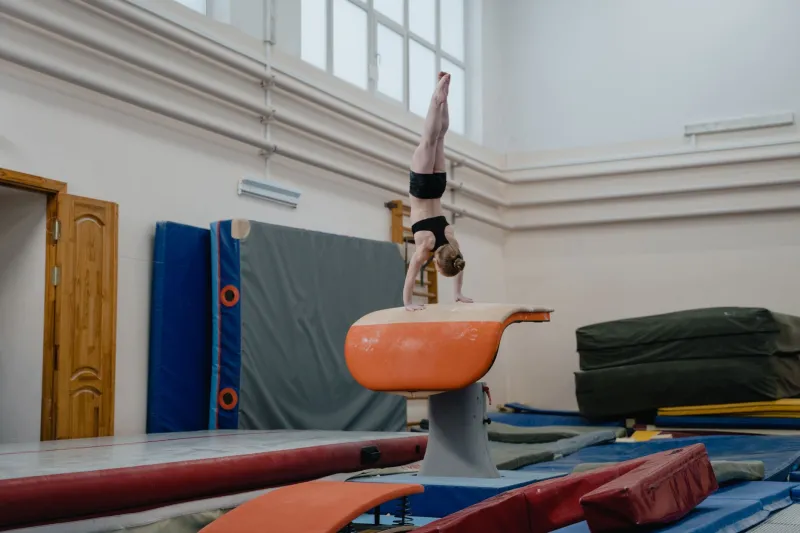
Photo: Ed Suter, CC BY-SA 4.0, via Wikimedia Commons
Ask a group of UK parents to picture a gymnast and many will still describe a girl in a leotard, hair tied back, waiting for her turn on the beam. It is a stubborn image, and it does boys a disservice. Gymnastics is not a single-lane sport. It rewards strength, control, courage and coordination — qualities no child has a monopoly on. Yet if you are the parent of a boy who wants to try it, you may have noticed that the welcome can be uneven. Some clubs are brilliant at it. Others are polite but passive, happy to take the fee while quietly treating boys as guests in a girls' world.
That gap matters. A boy who feels like an afterthought in the room is less likely to stick with a sport that could do him a lot of good.
The benefits are not a soft sell
Gymnastics is often sold to parents as a way to burn off energy. True enough, but it is also one of the most complete foundations a child can build. For boys, it develops upper-body strength, core stability, balance and flexibility at an age when those things are still being wired in. It teaches spatial awareness — where your body is, what it is doing, and how to adjust when something changes. That transfers to football, rugby, swimming, climbing, cycling and simply running about without falling over quite so often.
There is a quieter benefit too. Gymnastics asks children to try something difficult in front of other people. A boy who learns to attempt a skill, wobble, reset and try again is practising resilience in a very physical way. He is also learning to listen, wait his turn and take feedback — skills that rarely make the school report but matter enormously.
What genuine inclusion actually looks like
A poster with a boy on it is not proof of anything. Real inclusion is visible in the room. Are boys in the mainstream recreational classes, not just parked on a separate waiting list? Do coaches speak to boys and girls in the same way, with the same expectations and the same encouragement? Is there a pathway that feels real, whether that is boys' artistic gymnastics, floor and vault, team gym or simply a well-structured recreational programme?
It also comes down to small things. Kit guidance that does not make boys feel like they are wearing the wrong uniform. Language that avoids treating flexibility as a female trait. Coaches who notice when a boy is hanging back and quietly bring him into the group. And a club culture where parents do not raise an eyebrow when a boy says he does gymnastics on a Saturday morning.
A boys-only class can be a great option for some families, but it should not be the only way a club includes boys. Mixed sessions, done well, are often where the real confidence grows.
Questions worth asking before you book
Do not just ask, 'Do you take boys?' Ask, 'How do boys experience your club?' The answers will tell you more than the brochure.
- Are boys in your regular recreational classes, and roughly how many are in a typical session?
- What experience do your coaches have with boys who are completely new to gymnastics?
- Do you offer a boys' artistic pathway, team gym, floor and vault, or other progression routes?
- How do you handle comments about gymnastics being 'for girls' — from children or adults?
- What does the first month look like? Is there a trial, and how are groups organised?
- What are the changing and toilet arrangements, especially for younger children?
- Can parents watch, and how do you communicate progress?
- What are the costs and the commitment, including any competition or kit fees?
- How would you support a boy who is nervous, shy or not especially sporty?
A good club will welcome those questions. A defensive answer is useful information too.
The first term: small wins, low pressure
Help him settle by keeping the first few weeks simple. Arrive early enough to see the room before it fills up. Introduce him to the coach if that is not already part of the routine. Choose comfortable kit he can move in, and leave the pressure at the door. The goal of the first term is not a perfect cartwheel. It is turning up, joining in and finding one thing he enjoys.
After each session, ask what he did rather than what he got right. 'What was the best bit?' is a better question than 'Did you win?' Celebrate the small stuff: a braver jump, a steadier landing, a go on a piece of equipment he avoided last week. If he mentions a joke or comment that made him feel out of place, take it seriously and speak to the coach. Clubs cannot fix what they do not know about.
If he wants to compete
Some boys fall in love with the competitive side and some do not, and both are fine. If he does, ask early about the route. Boys' artistic gymnastics has a recognised competitive pathway in the UK, and many clubs also offer floor and vault, team gym or recreational awards. Competition should be a choice, not the price of admission. A club that can explain the options clearly — and the time and cost involved — is usually a club that knows what it is doing.
Watch the language at home
Well-meaning relatives can undo a week of confidence with one throwaway line. 'Isn't that a girls' sport?' is not a neutral question to a boy who has just spent an hour learning to hold a handstand. Keep the response calm and matter-of-fact: he enjoys it, he is getting stronger, and plenty of boys and men train in gymnastics. If he hears that from the adults around him, he is more likely to believe it himself.
The bottom line
Gymnastics is not a girls' club with a boys' side door. It is a sport built on strength, balance and control, and boys belong on the floor as much as anyone. At Affinity Gymnastics, the aim is simple: classes where every child is expected, not merely tolerated. Choose a club that can show you how that works in practice, ask the awkward questions, and give your son time to find his feet. The confidence he builds may surprise you both.