Ear Defenders in the Kit Bag: Finding a Gymnastics Class That Works for a Sensory-Sensitive Child
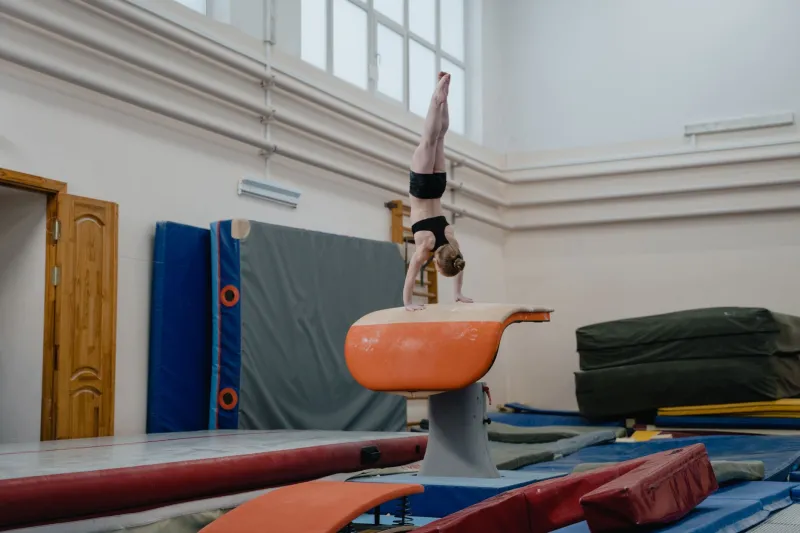
There is a particular sound a gymnastics hall makes on a busy Saturday morning. Springy floor, a dozen pairs of feet landing at slightly different times, a coach's voice bouncing off the wall, a whistle, someone's little brother shouting by the door. Plenty of children walk in, take one look and think: brilliant. Others walk in and want to walk straight back out.
Neither reaction is wrong. But if your child is in the second camp, it can feel as though the whole sport is closed off before they've even tried a forward roll. It isn't. Sensory-friendly gymnastics exists — sometimes as a dedicated session, sometimes as a set of adjustments within an ordinary class — and for a lot of families it's the difference between a child who dreads Tuesday and one who counts down to it.
What 'sensory-friendly' really means
It rarely means a separate, quieter building with no apparatus and soft furnishings everywhere. In most clubs it means a coach has thought hard about the sensory load of an ordinary session and trimmed it back.
In practice, that can look like:
- A smaller group, so fewer bodies are moving and less waiting in a queue happens
- Warm-ups done in a defined spot rather than scattered around the room
- Music turned down, or off entirely, and whistles swapped for a raised hand
- A visual schedule on the wall — now, next, then — so transitions aren't a surprise
- A designated quiet corner with a beanbag, a mat and a pair of ear defenders, which a child can use without needing to explain themselves
- The same coach each week, doing roughly the same warm-up in roughly the same order
None of that is exotic. Most of it is free. What it needs is a coach who is willing to plan for it.
Why the gym is hard work for some children
A gymnastics hall is a sensory minefield in the most literal sense. There's the echo of a high ceiling. There's the bright, sometimes flickering lighting. There's the smell of chalk and rubber matting. There are unexpected noises — a crash from the other end of the room, a coach clapping a rhythm, a child shrieking with delight. And there's the constant proximity of other people.
For a child with autism, ADHD, sensory processing differences, or simply a temperament that prefers a bit of warning before things change, that adds up. It isn't naughtiness. It's a nervous system doing a lot of work at once.
The good news is that a child doesn't need to be diagnosed with anything to benefit from a calmer setup. Clubs generally don't ask for a label, and they shouldn't. 'My child finds loud music and big groups difficult' is a perfectly complete sentence.
What a good session might look like
It starts before the child walks in. A coach might meet you at the door five minutes early, when the hall is still quiet, and walk your child round the room. This is the beam, this is where we put our bags, this is the corner you can go to if it all gets a bit much. That ten-minute tour removes a whole layer of the unknown.
Warm-up comes next, in a marked-out space, with instructions given one at a time. Transitions get a warning — 'two more goes, then we move to the mat' — rather than arriving out of nowhere. The child has a choice of two activities at some point, because a bit of control goes a very long way.
And at the end there's a predictable finish. The same stretch, the same goodbye, maybe a sticker or a handshake. Rituals like this are quiet magic: they tell the body that the hard part is over.
Questions worth asking before you book
Ring or email the club and ask directly. A good club will welcome this. A club that seems irritated by it has told you something useful too.
- How many children are in the class, and how many coaches?
- Could we visit and watch a session before joining?
- Is there a quiet space a child can step out to, and can they go without asking permission in front of everyone?
- Do you use music, whistles or clapping to signal changes?
- Would my child be able to keep socks on, or wear a long-sleeved top, if that helps them feel settled?
- Can I stay in the room for the first few weeks?
- Will it be the same coach each week?
- Do you use any kind of visual timetable or picture cards?
- What happens if my child needs to leave the room partway through?
- Is there a shorter trial session we could start with?
If the answer to most of those is a shrug, it doesn't necessarily mean the club is unkind — some coaches have simply never been asked. Sometimes asking the question is the thing that starts the change.
The small adjustments that pay off
A few things we've seen work, over and over. Arriving ten minutes early beats arriving two minutes late, every time. A one-page visual schedule photographed on a phone can be handed to a coach on day one. Ear defenders are allowed in most halls and nobody will look twice. And a short, honest chat on the phone before the first session — what your child loves, what sets them off, what calms them down — saves weeks of guesswork.
It also helps to be realistic about progress. Some children settle in a fortnight. Some take a term to get past the doorway. Both are fine.
You can always stay recreational
There's no rule that says a child has to move up, compete or train multiple times a week. If your child loves the foam pit, tolerates the warm-up and comes home smiling, that's a genuine gymnastics life. It doesn't need to be a pathway.
The last word
The gym doesn't have to be a place a child survives. With a smaller group, a raised hand instead of a whistle and a beanbag in the corner, it can be the best hour of their week. If your child is currently hovering by the door, it's worth asking the question. The answer is more often 'yes, we can do that' than you'd think.